
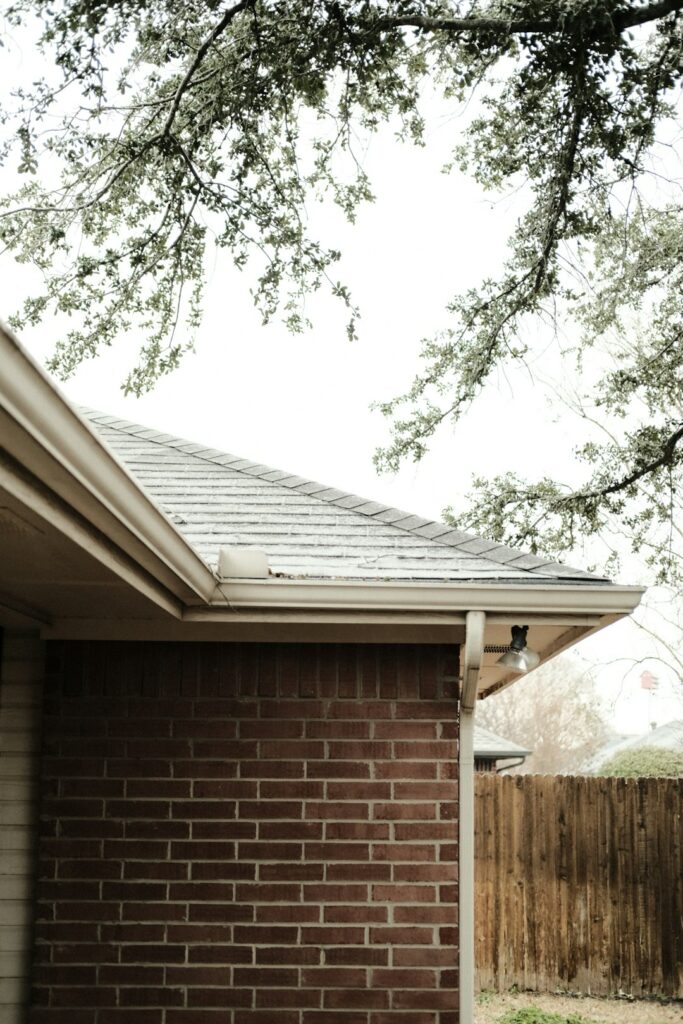
Why roof drainage matters in Henrietta, NY
A roof drainage system has one main job: move water from the roof to a safe discharge point without allowing it to collect against the house. In Henrietta, NY, that means preparing for steady rain, heavy snow, rapid thaws, and repeated freeze-thaw cycles.
A roof can be in good condition and still develop water-related problems if the gutters, downspouts, roof valleys, or ground drainage are poorly arranged. Overflowing water may stain siding, damage trim, saturate soil near the foundation, erode landscaping, or enter the basement and crawl space.
Effective drainage is not just about having gutters. It is about creating a continuous path from the roof surface to an area where runoff can disperse safely.
How should water move from the roof?
Rain and melting snow should travel through a planned sequence:
- Roof slopes direct water toward eaves and valleys.
- Flashing helps guide water around walls, chimneys, skylights, and other penetrations.
- Gutters collect runoff along the roof edges.
- Downspouts carry water to the ground.
- Extensions, splash blocks, swales, or underground systems move water away from the foundation.
- The surrounding soil or drainage system allows water to disperse without flowing toward buildings or neighboring properties.
Every part of this chain matters. A properly installed gutter cannot compensate for a clogged underground outlet, and a long downspout extension will not solve a roof valley that directs water behind the gutter.
What gutter practices provide reliable drainage?
Gutters should be securely fastened, correctly pitched, and sized for the roof area they serve. They should not sag between hangers or hold standing water after a storm. A small amount of water may remain temporarily, but persistent puddling often indicates inadequate slope, debris, or a damaged gutter.
Joints and end caps should be watertight. Seams that leak directly above siding, doors, or foundation walls can cause damage even when the gutter appears to be carrying most of the roof runoff.
Gutters also need enough capacity for concentrated flow. Roof sections with large surfaces, steep slopes, or multiple valleys can send more water toward a short section of gutter than a standard arrangement can handle. Valley areas deserve particular attention because water and debris often collect there.
A practical inspection should look for:
- Sagging sections or loose fasteners
- Water spilling over the front edge during moderate rain
- Rust holes, cracks, or separated seams
- Mud or plant growth inside the gutter
- Water stains below joints
- Gutter sections that pull away from the fascia
- Downspouts that remain full after rainfall
Where should downspouts discharge?
Downspouts should discharge far enough from the foundation that water does not immediately run back toward the basement or crawl space. The exact distance depends on the grade, soil, roof size, nearby pavement, and available drainage route.
A downspout should not simply release water at the base of the wall. That concentrates runoff beside the foundation, where it can increase hydrostatic pressure and contribute to dampness or seepage.
The discharge point should also avoid:
- Directing water onto walkways where ice may form
- Washing soil against the foundation
- Creating standing water beside a driveway
- Sending concentrated runoff toward a neighboring property
- Blocking a drainage swale or surface inlet
- Discharging onto areas that already stay wet
In Henrietta, local drainage rules address the need to prevent roof runoff from flowing onto adjacent properties. A change to downspouts, grading, or underground drainage should account for both the individual lot and the way water moves through the surrounding area.
Are underground downspout drains always a good idea?
Underground systems can be useful, but they are not automatically better than visible extensions. A buried line must have a suitable outlet, enough slope, and protection against clogging. If the outlet is blocked or the pipe settles, water may back up underground and remain unnoticed until the foundation becomes damp.
Before installing a buried drain, consider:
- Where the line will discharge
- Whether the outlet remains accessible for inspection
- Whether the soil drains adequately
- Whether tree roots may interfere
- Whether the line could freeze or become blocked
- Whether the route crosses utilities, pavement, or other drainage features

A visible extension is often easier to inspect and maintain. An underground system is most dependable when its route and outlet are clearly understood.
How should roof valleys, eaves, and flashing be handled?
Roof valleys collect runoff from two slopes, so they experience more water movement than most other roof areas. Leaves, pine needles, ice, and compacted snow can obstruct the valley or cause water to spill over the edge.
Valley flashing should be intact and properly integrated with the roofing materials. Water stains in an attic, damaged sheathing near a valley, or recurring leaks during heavy rain may indicate a drainage or flashing problem rather than a general roof failure.
At the eaves, the roof edge should direct water into the gutter instead of behind it. A small gap or misplaced edge detail can allow runoff to reach the fascia, soffit, and wall framing. This type of leakage may continue for months before becoming visible indoors.
What changes during winter?
Snow and ice create drainage problems that are less obvious than ordinary rain runoff. Snow can block gutters, while melting snow may refreeze at the eaves. Repeated thawing and refreezing can create ice buildup, especially where attic heat escapes unevenly or where gutters are shaded.
Residents should avoid climbing onto an icy roof or pulling heavy ice from the edge. Roof rakes may be appropriate for limited snow removal from the ground, but aggressive scraping can damage shingles and flashing.
Winter preparation includes:
- Clearing leaves before snow arrives
- Checking that downspouts are open
- Securing loose extensions before freezing weather
- Keeping discharge points away from walking surfaces
- Checking attic insulation and ventilation when ice buildup is recurring
- Watching for water stains after thaws
Ice at the roof edge is not always caused by poor gutters alone. Heat loss, air leakage, roof design, snow depth, and outdoor temperature can all contribute.
How often should roof drainage be inspected?
Most homes benefit from checking the drainage system at least twice a year: once in late spring and again in early fall. Additional checks are useful after major storms, strong winds, or periods of heavy leaf fall.
A ground-level inspection can reveal many problems safely. Look for overflowing gutters, displaced downspouts, erosion, wet foundation areas, and water marks on siding. During rainfall, observe whether water exits evenly or pours over a single section.
Roof access introduces fall hazards, particularly when surfaces are wet, icy, steep, or covered with moss. Conditions involving damaged flashing, structural movement, persistent interior leakage, unsafe access, or suspected foundation problems require qualified evaluation rather than trial-and-error repairs.
What is the most common drainage mistake?
The most common mistake is treating water at the foundation as a gutter problem only. Roof drainage, soil slope, driveway pitch, sump discharge, footing drains, and surface swales can all affect the same area.
A durable solution considers the entire route of water. The goal is not merely to remove water from the roof, but to prevent concentrated runoff from creating a new problem somewhere else on the property.
